Freelance invoicing software: free plans, 2.9% card fees, a 5-client cap
Freelance invoicing software is free until you pass 5 clients or $20,000 in revenue. The subscription is cheap; the 2.9% card fee on every invoice is not.
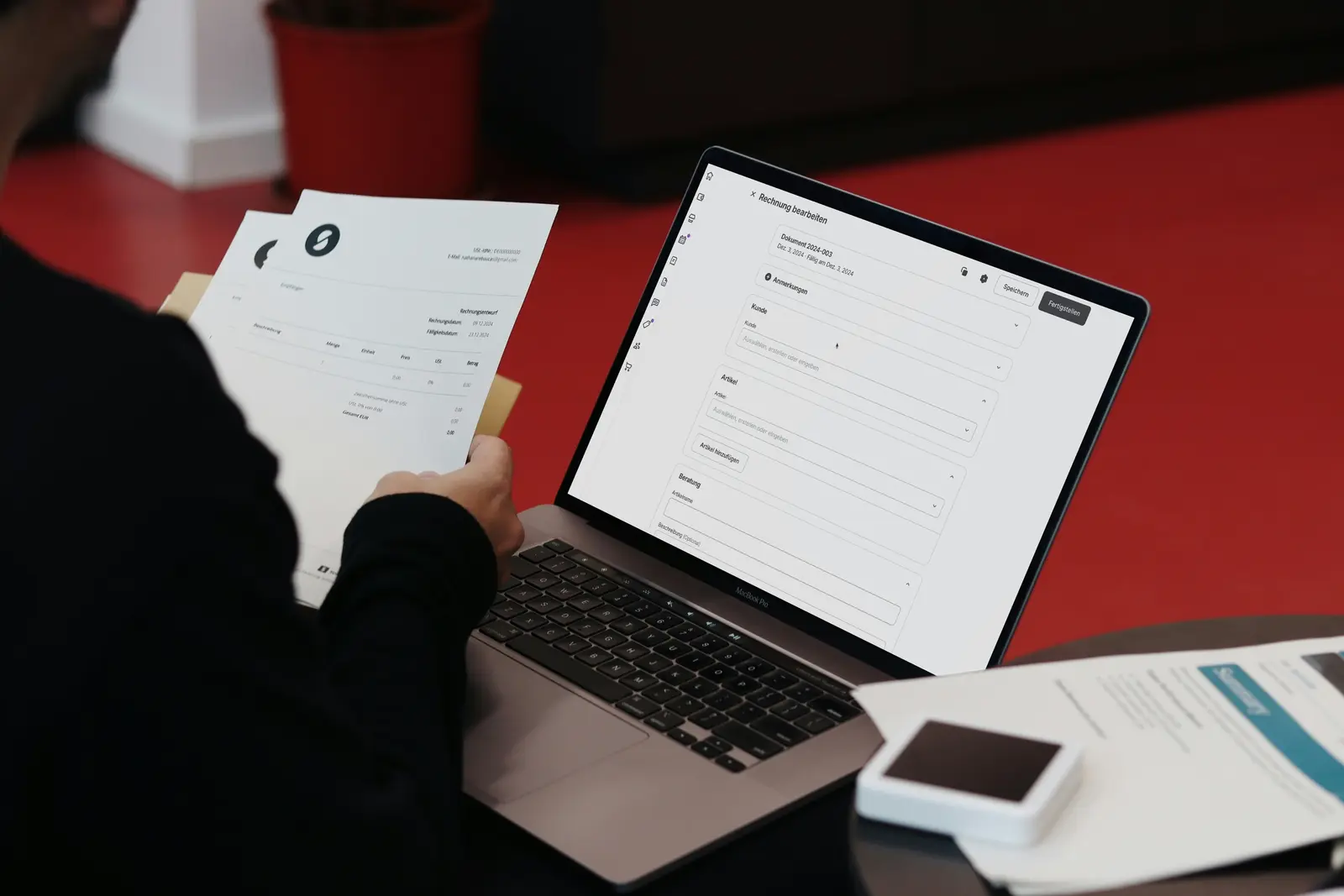
Freelance invoicing software runs from free to about $70 a month for a solo plan, and the free tiers cover most people in their first year. Zoho Invoice's free plan handles 5 clients and $20,000 of annual revenue. The subscription is rarely what costs you money: a 2.9% card fee on a EUR 2,000 invoice takes EUR 58 every time that client pays.
The case for paying for software is time and follow-up. Agiled's comparison puts the average freelancer's admin at about 15 hours a month, and Plutio's research puts the annual loss from late and unpaid invoices at $6,000 per freelancer. A tool that sends reminders and shows which invoices are overdue earns its fee at those numbers. A tool that only makes the PDF look better does not.
What the tools cost per month
Prices in the 2026 comparisons fall into three bands. Free: Wave, Zoho Invoice, Square, Indy, Nickel, Refrens, Bloom.io and Harlow all have a no-cost tier of some kind. Solo paid plans: Taskip from $12 a month per user, Plutio at $19 flat, FreshBooks from $19 to $70, Bonsai from $15 to $79, Dubsado free to 3 clients and $35 a month after that. Team suites cost more: HoneyBook is listed from $29 to $129, Agiled from $24 to $99, 17hats at $60.
Almost every vendor here publishes in dollars, and some list different entry prices in different comparisons. FreshBooks appears at $19, $21 and $23 for its cheapest plan depending on who wrote the table. If you pay from a euro account, the euro amount moves with the exchange rate and whatever conversion markup your bank or card adds. Check which currency the subscription is billed in before you take an annual plan.
| Tool | Monthly cost (USD as published) | Published processing fee | Free plan | Best for |
|---|---|---|---|---|
| Zoho Invoice | Free | Set by your gateway | Yes, 5 clients and $20,000 revenue | Multi-currency billing on a budget |
| Wave | Free to $16 | 2.9% + $0.60 | Yes, unlimited invoices | Basic invoicing, no time tracking |
| Taskip | From $12 per user | Not listed | Yes | Clients and projects in one place |
| Plutio | $19 | Via Stripe | No | Proposals, time tracking and invoices together |
| Bonsai | $15 to $79 | Via Stripe | No | Contracts plus invoicing |
| FreshBooks | $19 to $70 | 2.9% + $0.30 | No | Reporting for hourly work |
| Dubsado | $35 after 3 clients | Not listed | Up to 3 clients | Workflow automation for creatives |
| Agiled | $24 to $99 | Via Stripe or PayPal | No | Recurring billing on the Business tier |
| HoneyBook | $29 to $129 | 2.9% + $0.25 | No | Creative and event work |
The per-invoice fee matters more than the subscription
Take a freelancer who bills 10 clients a month at EUR 2,000 each. At the 2.9% rate in these comparison tables, the card fee is EUR 58 per invoice, or EUR 580 a month. Over a year that is EUR 6,960, against $228 a year for Plutio's flat plan. Whatever the exchange rate does, the fee is a multiple of the subscription rather than a rounding error.
The fixed part of the charge bites on small invoices. On a EUR 200 invoice, 2.9% is EUR 5.80. On a EUR 20 invoice it is 58 cents, and a fixed charge of 25 to 60 cents on top can double what the payment costs you as a share of the bill. If you bill in small amounts, look at the fixed fee; if you bill in large ones, look only at the percentage.
Your payment provider sets that rate, not the invoicing app. Most of these tools hand card payments to Stripe or PayPal and pass through what those providers charge. The 2.9% figures are the vendors' published rates, so your own provider's schedule for euro cards and for currency conversion is the number that will actually leave your account. Bank transfers avoid the percentage and cost you an hour a month matching payments by hand.
Where the free plans stop
Zoho Invoice's free tier ends at 5 clients and $20,000 in annual revenue. Dubsado's ends at 3 clients. Wave's Starter plan gives unlimited invoicing and expense tracking for nothing but charges a higher fixed fee per card payment, 60 cents against 30 cents at FreshBooks, and it has no time tracking. Square Invoices and PayPal let you send invoices free and take their cut at the payment instead.
So the free-versus-paid question is really about how many clients you bill and whether you need hours turned into invoice lines. Below five regular clients in one currency, a free plan and a spreadsheet of who has paid will do. Above that, $12 to $19 a month buys reminders, a client list and a record you can hand to an accountant.
If you invoice clients in more than one currency
Billing a UK client in pounds and a German client in euros narrows the field to Zoho Invoice, Invoice Ninja, Refrens, Agiled, Xero and tools connected to Wise. FreshBooks offers multi-currency on its paid plans. The feature list is the easy part. The cost sits in the exchange rate the tool applies and who absorbs it, so ask which rate you get and whether you or the client pays for the conversion.
Recurring invoices and retainers
If you bill the same amount every month, recurring invoices save the most time. Agiled's Business tier includes recurring billing within its $24 to $99 range. Invoice Ninja is built around scheduled retainer renewals and converts an accepted estimate into an invoice with the conversion history kept, which is why Worldmetrics puts it first for solo freelancers. Plutio's $19 Core plan covers unlimited invoices and projects, with tracked hours becoming invoice lines in one click, and suits project work better than flat retainers.
Which tool I would pick
Start on Zoho Invoice's free plan. It handles multi-currency and costs nothing until you pass 5 clients or $20,000 in revenue, so it is the cheapest way to find out whether you need anything more. Once you pass the cap, Plutio at $19 a month flat is the better buy for project work: unlimited invoices, tracked hours, proposals and a client portal in one place.
FreshBooks is worth the money if you want financial reports rather than invoices alone, though its Lite plan caps you at 5 billable clients. That is the same limit Zoho gives away free, which makes the paid version hard to justify at the start. For retainers, Agiled's Business tier is the option with recurring billing included rather than bolted on.
Skip paid software altogether if you send five invoices a month to three clients in one currency. You will spend more time setting up the tool than you save on invoicing.
What every invoice needs anyway
Whatever tool you use, the invoice itself needs the seller's and customer's names and addresses, a sequential invoice number, the issue date, a description of the work, the total and how to pay it. If you are VAT registered in the EU, it also needs your VAT number and the rate charged. Some EU countries now require structured electronic invoices between businesses, so check your own country's rule before committing to a tool that cannot produce one. That is general information; an accountant in your country is the right person to confirm it for your situation.
Frequently asked questions
- Is free invoicing software enough for a freelancer?
- Yes, if you bill in one currency to fewer than five regular clients. Zoho Invoice's free plan covers 5 clients and $20,000 in annual revenue, and Wave's Starter plan gives unlimited invoicing for nothing. Both make their money at the payment stage through card processing fees, so compare that rate before you commit.
- How much should I pay for invoicing software?
- $12 to $35 a month covers what a solo freelancer needs: unlimited invoices, reminders, time tracking and multi-currency. Anything above $60 a month usually pays for team seats, contracts or CRM features. Weigh the subscription against your card fees, because those are often the larger number.
- Can I invoice in euros and pounds from the same tool?
- Yes. Zoho Invoice, Invoice Ninja, Refrens, Agiled and Xero all handle more than one currency, and FreshBooks does on paid plans. Ask what exchange rate the tool applies and whether you or the client absorbs the conversion, because the rate is where the money goes.
- Do I need e-invoicing software in the EU?
- It depends on your country and your customers. Some EU states require structured electronic invoices between VAT-registered businesses; others accept PDFs. Check your own country's rule before choosing a tool, and confirm with an accountant, since a tool that cannot produce the required format is expensive to replace later.
- What is the cheapest way to get paid by a client abroad?
- Bank transfer, if you can wait a few days and match the payment yourself, because there is no percentage fee. Cards are faster and cost 2.9% plus a fixed charge on the published rates. On a EUR 2,000 invoice that is EUR 58, which you can weigh against a few days of waiting.
Sources
How we reported this story
Written by Nora Hale, Editor, The Finance Clarity.
- Sourcing. Every figure traces back to a primary source: regulators, central banks, or audited company filings.
- Independence. Affiliate relationships never influence a verdict. Sponsored placements are always labelled.
- Accountability. Every article carries a named byline, and is corrected or updated when the underlying figures change.
Further reading

Anthropic pays $1.5bn for pirated books; authors get $1,500
Anthropic's $1.5bn settlement with authors works out at about $3,000 per book, split with the publisher and taxable. What European writers should expect, and when.

Pablo Hernández de Cos takes the ECB: what it means for your money
Pablo Hernández de Cos has been nominated to lead the ECB from February 2027. His preference for lower rates meets 4% inflation, and savers and mortgage holders should plan for delay.

Protect savings from inflation: €10,000 at 2% loses €160 a year
Your savings lose value whenever the after-tax interest rate sits below inflation. The break-even rate is inflation divided by one minus your tax rate, and it is higher than most people expect.